- home
- testimonials
- diagnosing damp
- moving home?
- timber decay
- solid wall insulation
- dry rot
- pre-purchase report
- enquiry form
- case histories
- guarantee adoption
- fees for survey/ mortgage retention specials
- treatment options
- contact us
- environmental control
- condensation
- recession update
- damp & decay related articles
MONEY/MORTGAGE SAVING CASE HISTORIES
Even with the recent ‘help to buy’ schemes which are intended to help
property buyers lenders are releasing mortgage monies for house
purchases, re-mortgaging and equity release only after borrowers satisfy
strict criteria and jump through several hoops to obtain a mortgage.
The Valuation/Building Survey carried out for the lender invariably
notes dampness and timber decay and will put a retention on the mortgage
or even hold back all of the money until damp & timber reports are
obtained and the work carried out. Unfortunately this has led to the
rise of some damp-proofing and timber treatment companies, including
Property Care Association (PCA/BWPDA) members, ‘diagnosing’ rising damp
and woodworm after carrying out free damp and timber surveys.
We can help you avoid these unnecessary damp and timber treatments and
if you in the process of obtaining a buying a house or obtaining a
mortgage we can carry out independent, impartial damp and timber surveys
by qualified surveyors who are not intent on selling chemical
damp-proofing or timber treatments. These comprehensive damp and timber
reports will satisfy your lenders demands so that your mortgage is
processed successfully without the need for any damp-proofing or timber
treatments.
Below are some of the cases that we have helped recently:
Ponding on paving slabs causes ‘rising damp’-Leaswood
Place , Newcastle, STAFFS ST5 4BU-February 2015.
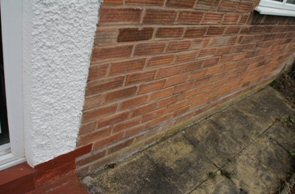 |
Slate damp-course visible in thick mortar joint at base of wall. Plenty of clearance between damp course and ground | |
|
Our client asked a Property Care Association member damp-proofing and timber treatment company to carry out a damp survey on this 1940s built property as they suspected that they had a rising damp problem. Even though the house had a perfectly good damp course which was still preventing rising damp the PCA damp survey recommended damp-proofing and plastering with a cost of over£2,500. We found that paving slabs had been laid in the garden at the rear of the house and these were partially bridging the damp course and water ponding on the slabs was absorbed into the walls which then migrated through the brickwork by capillary action to appear as rising damp internally. |
||
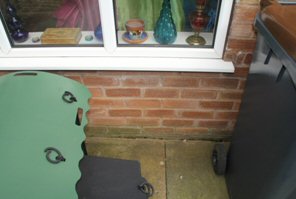 |
Slabs level with damp course allowing water ingress and rising damp internally. | |
No damp-proofing works were required and the dampness was alleviated by
excavating a ventilated drainage channel at the base of the affected
wall at a fraction of the cost of chemical damp-proofing and
replastering.
Bridged damp course causes ‘rising damp’-Necton
Street, Syston, Leicester LE7 1HF-January 2015.
Most damp surveyors have a default setting to recommend chemical
damp-proofing and water proof plastering as a solution to any dampness
that may be at the base of the wall and a Leicester based Property Care
Association member damp-proofing and timber treatment company
recommended this treatment at this 1900 built terraced house even though
it had a perfectly good slate damp-course and a band of blue engineering
bricks at the base of the wall which also stops rising dampness.
Our survey found that the dampness was due to partial bridging of the
damp-course by raised ground levels which was allowing water to pond at
the base of the walls leading low level water ingress and induced rising
damp internally. Rising damp can be controlled without any damp-proofing
work being required by ensuring that the evaporation rate from the wall
is greater than the water uptake and we therefore recommended the
installation of a ventilated drainage channel which will allow water to
drain away and also let moisture evaporate from the brickwork . Our
client carried out this work himself and saved over £4,000 by avoiding
unnecessary, expensive and disruptive chemical damp-proofing.
House with five forms of damp-proofing needs new
damp-proof course-Middleton Hall Road, Birmingham B30 1BY-November 2014.
This semi-detached house in Kings Norton was built with a slate damp-proof
course and like most houses in Birmingham had a band of blue engineering
bricks at the base of the wall which are almost impervious to water and
act as a further barrier to dampness. An electro-osmosis damp-course,
chemical damp-proofing together with waterproof plastering had also been
installed during previous renovation works yet a Solihull based PCA
member damp-proofing and timber treatment company said that over three
thousand pounds worth of damp-proofing work was still required.
We checked all the walls identified on the PCA members’ damp report and
found that there was no rising dampness and no damp-proofing works were
required. We checked all skirting boards abutting potentially damp walls
and these had an average reading of less than 6% which is too low to
sustain decay and indicates that the background wall is free from damp
and there was no justification for another injected damp-proof course.
The only work that was required was reduction of ground levels to
prevent any low-level moisture ingress and some gutter repairs to
prevent any penetrating dampness.
Low-level water ingress misdiagnosed as Rising
Damp-Sunniside, North Shields, Tyne & Wear NE29 7JJ-November 2014.
This 1930’s house was built with a slate damp-proof course which will
still be effective in controlling rising dampness but a Morpeth based
damp-proofing and timber treatment firm carried out a free survey and
said that rising damp was present throughout the ground floor and
damp-proofing and waterproof plastering costing around £3,500.00 were
required. We inspected all the walls noted on their damp report and
found that there was no rising dampness and no need for a chemical
damp-proof course. The only damp we found was on a rear wall near the
door to the back garden where there was some water seepage at the base
of the door frame which was alleviated by applying waterproof mastics to
the door frame and coating the wall with a silicon water repellent.
Internally the only work that was required was the replacement of a damp
section of skirting board wit pre-treated softwood. These works were
carried out by a local builder for less than£150, saving our client over
£3,300.00
Cellar flood causes rising damp.Fellbrigg Road,
East Dulwich,London SE22 9HQ-August 2014.
Flooding to the basement of this terraced house had caused a build-up of
water vapour in the sub-floor void which condensed on exposed masonry
and this led to induced ‘rising damp’ appearing on internal walls where
there was no other source of moisture. Our client had a free damp survey
carried out by Kenwood who recommended around £6,000.00 worth of
damp-proofing and replastering work which he used to get a price
reduction on the house. Our damp survey found that as well as the
flooding of the basement that air bricks had been blocked and the was
virtually no sub-floor ventilation which was allowing even greater
humidity levels than usual under the floor.
The work repairing the water leak and installing extra air bricks was
sufficient enough to stop further dampness and dry out the sub-floor
timbers and walls and there was no need for any chemical damp-proofing.
The works were undertaken by our client’s builder during renovation
works and cost less than £500.00
Black ash mortar damp readings. Luckwell Road,
Bedminster , Bristol BS3 3HD-July 2014.
This terraced house was built around 1900 and a slate damp-proof course
was fitted at the time of construction and was still effective in
controlling rising dampness but the walls had been plastered with a
black ash mortar and as the property had been suffering from some
dampness the house owner has a couple of free surveys carried out a by
Bristol base damp-proofing & timber treatments companies. Because of the
conductivity of black ash mortar very high readings were recorded on a
moisture meter and the damp-proofing contractors said this was due to
rising damp and therefore recommended chemical damp-proofing and
waterproof plastering costing over £3,000.00.
We carried out a further survey taking plaster samples from the walls
and using thermal imaging cameras and digital hygrometers and we found
that the cause of the problem was condensation dampness and no
damp-proofing works were required and the only remedial works that were
required was the installation of passive dehumidifiers to allow excess
water vapour to be vented externally. These vents cost around £40-£50
and were fitted by our clients builder so savings of around £2,800.00
were made.
Bridged damp-course and blocked air bricks causes
‘rising damp’ – Melford Road, East Ham,LONDON E6 3QX-June 2014.
The buyers’ mortgage survey said that there may be damp in external
walls so the estate agent arranged for a free survey from an East London
based damp-proofing company. They said in a typical standard damp report
that ‘This rising dampness is most likely to have been caused by the
absence of a damp proof course or the breakdown of the existing damp
proof course’ and recommended damp-proofing and water-proof plastering
costing around £4,500.00. The property was built around 1910 and a slate
damp-course was visible at the base of external walls but this has been
partially bridged where ground levels had been raised when a concrete
patio base was laid causing water penetration into the brickwork and
ultimately induced rising damp internally.
Slate damp-proof courses never break down and even if they crack
slightly due to building movement they will still be effective in
controlling rising damp and therefore no damp-proofing work s were
required and all that was needed was the lowering of ground levels to
expose the damp-course which would stop the bridging effect and also
allow the brickwork to breathe and let moisture evaporate externally.
The raised patio had also partially blocked air bricks and tis was
restricting sub-floor ventilation and allowed a build-up of water vapour
under the floor which condensed on exposed brickwork causing further
rising damp internally. We opened up existing air bricks and installed
extra units so that the number and configuration of vents complied with
current Building Regulations and these improvements provided a robust
flow of air under the floor to purge excess moisture from the floor void
which helps dry both walls and sub-floor timbers.
The reduction of ground levels and modification to the
air-bricks/sub-floor ventilation were sufficient enough to remove any
‘rising dampness’ from the walls and no chemical damp-proofing works
were required. The total cost of the work was around £1500.00, saving
our clients £3,000.00 as well as avoiding all the disruption that comes
with damp-proofing and plastering works.
Bridged d.p.c. leads to ‘rising damp’ – Liverpool
Road, Irlam , Manchester M44 6AZ-May 2014
A mortgage survey for the potential buyer of this property stated that
rising damp may present and that a damp survey should be carried out. A
free survey by a Manchester based damp-proofing firm agreed with the
mortgage valuer and submitted a damp report with recommendations of
chemical damp-proofing and plastering at a cost of £5,000.00.The seller
of the house was not happy with this so he asked us to carry out a damp
survey. We found that the property was built with a slate damp-course
but this had been partially bridged by raised ground levels which were
allowing water to accumulate at the base of the walls and migrate into
the brickwork causing rising damp internally.
We recommended the installation of a drainage channel at the base of the
walls to allow rainwater to drain away and remove the moisture reservoir
that was causing the dampness. Both the seller and buyer were happy with
our report and recommendations so the report was sent to the lender and
the mortgage was granted without any retention clauses.
Block paving causes induced ‘rising damp’ – Camp
Road, St Albans, Hertfordshire, AL1 5DX-April 2014
A re-mortgage survey report included the caveat that there may be some
rising damp so the house-owner arranged for a Watford based PCA member
damp-proofing and timber treatment company to carry out a free damp
survey. They diagnosed rising damp and recommended damp-proofing and
associated water-proof plastering. The property was built with a slate
damp-course and had already had a chemical damp-proof course installed
during previous renovation works so no further damp-proofing should have
been required. Our inspection of ground levels externally noted that the
block paving at the front of the house had partially bridged the damp
course and was causing water penetration at the base of the wall leading
to ‘rising damp’ internally. We recommended the removal of the course of
bricks adjacent to the house to create a drainage channel at the base of
wall. This allowed rainwater to drain away before it could be absorbed
into the walls and there was no need for any chemical damp-proofing. We
submitted our report to the lender and the re-mortgage was granted
without any clauses for damp-proofing work.
Bridged damp course leads to ‘rising damp’ –
Chestnut Rise, Plumstead, South London SE18 1RJ-March 2014
Our client had bought this house to renovate and then let out as part of
his ‘Buy to Let’ investment portfolio so knew there was some dampness in
some walls and had a free survey by a South London PCA member
damp-proofing and timber treatment company who diagnosed the problem as
rising damp and recommended chemical damp-proofing and waterproof
plastering which totalled around £5,000. Our external inspection of the
house noted that the slate damp-proof course had been bridged by
concrete paving all round the house and also the air bricks had been
blocked by the raised ground levels. The combination of low-level
moisture ingress into the brickwork and lack of sub-floor ventilation
had led to ‘rising damp’ internally. We recommended the installation of
a drainage channel at the base of walls and the re-instatement of the
air bricks. Once this work was carried out by his builders the walls
started to dry out gradually and there was no need for any chemical
damp-proofing.
Plumbing leaks cause ‘rising damp’ – Risley
Avenue, Tottenham, LONDON N17 7EU- February 2014
This basement flat had been renovated around 10 years ago and the work
had included the replacement of the original timber floor with a solid
slab/screed together with damp-proofing and water-proof plastering so no
further damp-proofing should have been required but a free survey by a
Property Care Association (PCA) damp-proofing and timber treatment
company recommended the installation of a chemical damp-proof course
with waterproof sand/cement rendering cost £5,900.00 to most of the
walls that had previously been treated. Our survey found that this
dampness diagnosed as ‘rising damp’ was due to previous plumbing leaks
which had allowed water to sit on the concrete floor and absorbed into
the brickwork leading to induced ‘rising damp’. No damp-proofing works
were required and all that was needed was some minor redecorating to
spoiled surfaces which cost less than £200.00 to carry out.
Boiler leak causes ‘rising damp’ – Risley Avenue,
Tottenham, LONDON N17 7EU- February 2014
This basement flat had been renovated around 10 years ago and the work
had included the replacement of the original timber floor with a solid
slab/screed together with damp-proofing and water-proof plastering so no
further damp-proofing should have been required but a free survey by a
Property Care Association (PCA) damp-proofing and timber treatment
company recommended the installation of a chemical damp-proof course
with waterproof sand/cement rendering cost £5,900.00 to most of the
walls that had previously been treated. Our survey found that this
dampness diagnosed as ‘rising damp’ was due to previous plumbing leaks
which had allowed water to sit on the concrete floor and absorbed into
the brickwork leading to induced ‘rising damp’. No damp-proofing works
were required and all that was needed was some minor redecorating to
spoiled surfaces which cost less than £200.00 to carry out.
Boiler leak causes ‘rising damp’ – Crossfields
Road, Belsize Park, LONDON NW3 4NS- February 2014
This basement flat had been renovated around 10 years ago and the work
had included the replacement of the original timber floor with a solid
slab/screed together with damp-proofing and water-proof plastering so no
further damp-proofing should have been required but a free survey by a
Property Care Association (PCA) damp-proofing and timber treatment
company recommended the installation of a chemical damp-proof course
with waterproof sand/cement rendering cost £5,900.00 to most of the
walls that had previously been treated. Our survey found that this
dampness diagnosed as ‘rising damp’ was due to previous plumbing leaks
which had allowed water to sit on the concrete floor and absorbed into
the brickwork leading to induced ‘rising damp’. No damp-proofing works
were required and all that was needed was some minor redecorating to
spoiled surfaces which cost less than £200.00 to carry out.
‘Free damp survey’ says slate damp-course failed–
West Hill, Wantage, OXFORDSHIRE OX12 9EF. February 2014
The seller of this 1930s semi-detached house in Wantage had a free damp
survey carried Property Care Association member damp-proofing firm based
in Abingdon who stated that ‘rising damp was present due to the failure
of the original slate damp-proof course ‘ and then recommended a full
damp-proof course and waterproof plastering to all external for around
£4,000. Slate damp course rarely fail and provide that they are not
bridged by raised ground levels which still be effective in controlling
rising damp
We carried out a damp survey and found that most areas highlighted on
the free damp survey were free from damp and no damp-proofing was
required .There was some minor damp on the front wall which was due to
the garden being slightly raised above the damp course leading to
low-level water ingress and ‘rising damp’ internally. This was easily
alleviated by reducing ground levels so that they were 150mm below the
damp course. The cost of this was negligible as it was carried out by
our client and just involved a bit of digging instead of wasting £4,000
and on pointless chemical damp-proofing works and waterproof plastering.
‘Free damp survey’ diagnoses rising damp– Souldern,
Bicester, OXFORDSHIRE OX27 7JE. December 2013
A homebuyers report recommended a damp survey and a Property Care
Association member damp-proofing firm carried out a free damp survey and
recommended a full damp-proof course and waterproof plastering
throughout the ground floor at cost of over £11,000. The property is a
two hundred year old stone built cottage and chemical damp-proofing in
stone walls is rarely effective as most of the damp-proofing fluid runs
away within the rubble infill and most contractors rely on the
waterproof render to stop any dampness.
We carried out a damp survey and found that most of the property was
free from damp and the only areas affected by damp were the front and
rear elevation walls and this dampness was due to low level moisture
ingress where water was ponding on concrete at the base of the walls.
This was easily rectified by installing drainage channels at the front
and rear of the house at a cost of less than £1,000 and no chemical
damp-proofing works or waterproof plastering works were required.
Bridged damp-proof course causes ‘rising damp’–
Baytree Road, Weston-Super-Mare, North Somerset BS22 8HW. October 2013
A mortgage survey on this 1930s semi diagnosed rising damp and a free
survey was carried out by a Bristol based damp-proofing and timber
treatment contractor who then recommended the installation of a chemical
damp-proof course together with the removal/replacement of plaster with
a waterproof render to all external walls-total cost £3,500.00. We found
that this work was not required as there was a perfectly good bitumen
damp-proof course visible in all the external walls which was still
effective in controlling ring dampness from the ground. Dampness had
been caused by concrete paving at the base of front and rear walls
partially bridging the damp-proof course leading to water ingress into
the brickwork and ‘rising damp’ internally. No damp-proofing works were
required and all that was need was a drainage channel at the base of the
front and rear walls which cost around £600.00.
The work was completed by a local builder and then re-inspected by us in
order to issue a guarantee against the recurrence of rising damp to
satisfy mortgage requirements
Free damp survey misdiagnoses ‘rising damp’–
Carver Road, Herne Hill, South London SE24 9LS. September 2013
Our client had just bought this house and the mortgage survey said there
may be damp so the estate agent had a free damp survey undertaken by a
South London based damp-proofing company who said that rising damp was
present and recommended damp-proofing and plastering for around £2,000.
The house-owner wasn’t happy with this as she couldn’t see or smell any
damp and also the damp-proofing work would have also involved ripping
out all the kitchen units so she asked us to carry out a damp survey. .
We inspected the house from the outside first and noted that ground
levels had been raised at the rear of the house when paving slabs had
been laid in the garden. Internally the only sign of damp was where the
damp-course had been bridged by the paving which had cause low-level
moisture ingress and rising damp. All that was needed to prevent further
damp was the excavation of a drainage channel at the base of the wall to
allow rainwater to run-off before it could be absorbed into the
brickwork and no damp-proofing works were required.
Low-level moisture ingress causes ‘rising damp’–
Kemerton Road, Camberwell, South London SE5 9AP. September 2013
The owner of this house was selling it to move out of London and
everything with the sale was going fine until the survey report came
back and stated that there may be damp and timber problems. The buyer
then got a free survey carried out by one of the largest damp-proofing
and timber treatment companies in London who recommended damp-proofing,
waterproof plastering and timber treatment at a cost of around £4,000.00
after just inspecting the property internally. We carried out and
inspection externally and internally and found that there was some
slight damp on the front bay but this had been caused by partial
bridging of the damp course where the garden had been concreted over .
No damp-proofing works were required and all that was needed was
lowering of ground levels and installation of a couple of air bricks
costing around a quarter of the original price for dpc work.
Free damp survey finds rising damp– Fernholme
Road, Nunhead, South London SE15 3EF. August 2013
Our client had bought this 100 year old terraced house a couple of years
ago and a free damp survey had been carried out by a South London base
damp-proofing firm who recommended around £10,000 worth of damp-proofing
and waterproof plastering based solely on the use of a moisture meter
when guidance notes issued by the Property Care Association say that
rising damp cannot be diagnosed with the use of a damp meter. He thought
this was a bit too much as he couldn’t smell any damp or notice any damp
plaster so asked us to carry out a more in depth survey and after taking
plaster samples and checking all timbers abutting potentially damp wall
we found that there was no rising damp and the existing slate damp
course was working perfectly well and that the only slight damp was at
the base of external walls which had been caused by raised ground levels
partially bridging the damp course. This was easily rectified by
installing a drainage channel at the base of the walls which cost around
£800.00.
Blocked drain causes low-level water ingress and
‘induced rising damp’ – Queenhill Road, Northenden, Manchester M22 4HW-
August 2013
A mortgage survey picked up dampness on the rear wall of this house and
recommended further investigation so the estate agent arranged for a
free survey undertaken by a Manchester based damp-proofing company, who
diagnosed ‘rising damp’ and recommended damp-proofing and waterproof
plastering throughout the ground floor at a cost of around
£3,500.00.This resulted in the bank putting a retention on the mortgage
until this damp-proofing work was carried out. We found that most of the
walls were free from damp and the damp on the rear wall was due to the
drain being blocked causing flooding in the back yard which saturated
the brickwork and caused ‘rising damp’ internally. No damp-proofing
treatments were required the only work that was needed was cleaning of
the drains and replacement of damaged plaster internally which in total
cost less than £500.00. Our client submitted our report to his lender
and they were satisfied with our findings and lifted the retention
clause and stipulation that damp-proofing works must be carried out from
their mortgage offer.
Damp-proofing surveyor using meter ‘diagnoses’
rising damp Newton Road, Bishop’s Stortford, CM23 3SB - July 2013
A mortgage surveyor stated that there might be damp present in this
terraced house and a damp survey was required before a mortgage could be
granted so the estate agent arranged for a free survey by a PCA member
damp-proofing company who specialise in carrying out free damp and
timber surveys. Their surveyor armed with a Protimeter found damp in
most walls and recommended around five thousand pound worth of
damp-proofing work. Both the buyer and seller of the house were not
happy with this survey/quote as the house had been damp-proofed only a
few years ago and this work had included the replacement of plaster and
timber floors. We were asked to carry out an independent damp survey
which did not rely on the use of a moisture meter to diagnose rising
damp. We took readings from the plaster with a Protimeter and above
average readings were recorded, and this is usually enough for a
damp-proofing surveyor to say that the problem is risng damp and then
recommend a new damp-course even though these meters are well known not
to be accurate on plaster, so we took readings from the skirting boards
fitted to these ‘damp’ walls and the readings obtained were around 5-6%
which is reasonably dry for timber indicating that the walls were not
damp but to confirm this we took plaster samples from the wall to
determine the true moisture content. After drying the samples in an
Adams AMB50 moisture balance the average moisture content of samples was
less than 6% which is acceptable for plaster and there was no
justification for any damp-proofing works. Both the buyer, seller and
more importantly, the mortgage provider were all happy with our report
and the sale of the house went through successfully.
Leaking gutter causes low-level moisture ingress
and ‘induced rising damp’ – West Avenue,Harton , South Shields, Tyne &
Wear NE34 6QU- July 2013
Our client was buying this terraced house which was built with a
physical damp-course and also had an injected damp-proof course
installed around 10 years ago. The combination of these two damp-proof
courses will have been sufficient to prevent any rising dampness but a
free survey undertaken by a Sunderland based damp-proofing company,
carried out because of a mortgage requirement, diagnosed ‘rising damp’
and recommended even more chemical damp-proofing and waterproof
plastering at a cost of around £3,000.00 which resulted in a retention
by the mortgage provider. We found that was some slight dampness on the
front elevation wall but this had been caused by an overflowing gutter
causing rainwater splashback and water penetration into the brickwork
leading to induced rising damp internally. No damp-proofing works were
needed and all that was required to prevent further dampness was the
unblocking and cleaning of the gutters which were undertaken by a local
bolder for around £200.00. We submitted our report to the lender and the
y were satisfied with our findings and lifted the retention clause from
their mortgage offer.
Plaster bridging damp course causes ‘rising damp’
– Randolph Road, Maida Vale, London W4 2HQ- June 2013
This basement flat had been renovated around 10 years ago and the work
had included the replacement of the original timber floor with a solid
slab/screed together with damp-proofing and water-proof plastering. The
solid floor has the effect of displacing moisture that was previously
vented via air bricks and pushes dampness to edges of rooms and plaster
had been finished flush with the floor causing bridging of the damp
course and induced rising damp in walls. A free survey by a PCA
damp-proofing and timber treatment company recommended the installation
of a chemical damp-proof course with waterproof sand/cement rendering
cost £5,400.00 to most walls. During our survey we had to take off
skirting boards to confirm that plaster was bridging the damp course and
this enabled us to minimise the work to the removal of 50mm of plaster
at the base of the walls to prevent continued capillary action and no
damp-proofing works were required.The total cost of these modifications
was around £800.00, saving our client £4,600.00
Never trust a man with a meter.Croft
Road,Newmarket,Suffolk CB8 0AQ.June 2013
Our client was buying this Victorian semi-detached house and dampness
was picked up on the mortgage valuation survey so the estate agent
arranged for a free damp survey by a Cambridge based damp-proofing and
timber treatment company. Using a moisture meter they asserted that high
damp readings were due to the failure of the original slate damp-proof
course and recommended the installation of a new chemical d.p.c. and
water-proof plastering at a cost of around £3,500.00. We were asked to
carry out further survey to include sampling of plaster. We found that
although there was some surface dampness this was due to condensation
which was confirmed using a digital hygrometer and surface thermometer
to determine relative humidity and dew point temperature. We also took
samples from the wall and using the oven-drying method of moisture
determination proved that the capillary moisture content was less than
5% and there was no need for any chemical damp-proofing. Even after
allowing for our survey fee our client saved over £3,200.00 and avoided
the need for unnecessary and disruptive chemical damp-proofing.
Homeowners should never depend on surveys and reports which rely solely
on the use of hand-held moisture meters as they give inaccurate and
misleading readings which are often used by damp-proofing companies to
sell chemical damp-proofing.
Rising damp or low-level moisture ingress
Carterspiece, Coleford, Forest of Dean, Gloucestershire.May 2013
During the selling of this stone built cottage the estate agent arrange
for a free damp survey to be carried.
A Hereford based, Property Care Association member, damp-proofing and
timber treatment company undertook the free damp survey and found
‘rising damp’ in most of the walls when using a moisture meter and
quoted for damp-proofing and plastering at a cost of over £5,200.00.
They recommended the injection of a chemical damp-proof course when most
people know that this is virtually useless in a stone wall as the fluid
just runs away in the rubble infill and no doubt the treatment company
would just rely on the waterproof render to hold back any damp.
Moisture meters are not calibrated for use on plaster and the readings
obtained are often mis-leading and result in the mis-diagnosis of rising
damp and unnecessary damp-proofing and plastering. We therefore took
samples from the walls and dried them in a moisture balance which showed
that there was only one area of damp on the front wall and this was due
to water ponding on a concrete abs e at the front of the house. No
damp-proofing works were required and all that was needed was the
installation of a drainage channel at the base of the wall which was
done by a local builder for less that £600.00.
Homeowners should never depend on surveys and reports which rely solely
on the use of hand-held moisture meters as they give inaccurate and
misleading readings which are often used by damp-proofing companies to
sell chemical damp-proofing.
Free damp survey recommends whole house
damp-proofing– Northbridge Street, Shefford, SG17 5DH. April 2013
Our client was in the process of buying this terraced house and received
a building survey report which stated that it was ‘a damp property with
significant areas of dampness ’ and recommended further investigation.
A Bedfordshire based, Property Care Association member , damp-proofing
and timber treatment company carried out a damp and timber survey and
quoted for damp-proofing and plastering at a cost of around £1,900.00
plus spaying the roof with an insecticide as they found light ,scattered
infestation of woodworm activity.
Our survey noted that the house was built with a physical (slate)
damp-proof course which, contrary to assertions by most damp-proofing
companies, rarely break down and this had been supplemented by a
chemical damp-proof course and water-proof plastering system. The
combination of the original physical damp-proof course and the injected
d.p.c. were sufficient to prevent any further rising dampness and the
only damp that we found was on the front wall where residual moisture in
the wall had been pushed up passed the section of water-proof plaster
and caused some slight staining on the plaster. No damp-proofing works
were required and all that was needed was the removal of the damp
section of plaster and replacement with a renovating plaster.
We also inspected the roof space for woodworm and found that there was
no active woodworm or fungal decay and therefore no justification for
chemical preservative treatments.
Our report was submitted to our client’s lender and they accepted our
findings and removed the retention clause eon the mortgage offer.
We found that there was some low-level damp penetration at the base of
the walls caused by slightly raised ground levels which had partially
bridged the original damp-proof course and this could easily be
rectified by either lowering ground levels or installing a drainage
channel at the base of the external walls at a cost of less that
£500.00.
We submitted our report to the buyer’s lender and they accepted our
findings and granted a mortgage without any retention for damp-proofing
works.
Free damp survey finds rising damp– Highham Hill
Road, Walthamstow, London E17 5QY. April 2013
We were due to carry out a pre-purchase damp survey on this ground floor
Warner flat in Walthamstow when the purchaser phoned us a couple of days
beforehand to cancel as the estate agent had arranged for a free damp
and timber survey from a Walthamstow based damp-proofing and timber
treatment company. A couple of weeks later the buyer phoned us again and
asked us to go ahead with our survey as the free damp and timber survey
had diagnosed rising damp in all the external walls and the recommended
damp-proofing and plastering works were going to cost approximately
£4,500.00.
We found that there was some low-level damp penetration at the base of
the walls caused by slightly raised ground levels which had partially
bridged the original damp-proof course and this could easily be
rectified by either lowering ground levels or installing a drainage
channel at the base of the external walls at a cost of less that
£1,000.00.
We submitted our report to the buyer’s lender and they accepted our
findings and granted a mortgage without any retention for damp-proofing
works.
Low level moisture ingress causes rising damp– Anglesey Road, Enfield EN3 4HZ. April 2013
A North London based damp-proofing and timber treatment company stated ‘Tests with a moisture meter showed high readings indicating there is rising damp due to the lack or breakdown of the damp-proof course’. They then recommended that a new chemical damp-proof course should be installed into the walls, together with extensive re-plastering works internally at a cost of around £6,500.00.
We found that the damp was due to raised ground levels leading to low-level moisture ingress which then causes ‘rising damp’ internally. Chemical damp-proofing should only be considered when all building defects causing dampness have been rectified and we therefore suggested installing a drainage channel at the base of the affected walls which will remove the moisture reservoir that was causing the dampness and prevent any rainwater ponding which was the actual cause of dampness.
These works were carried out by our clients’ builder at less than a quarter of the price of the recommended damp-proofing works.
Leaking tap causes induced rising damp– Hollybush,
Blackwood, Gwent, South Wales NP12 0SW. February 2013
Our client was in the process of buying this terraced cottage and the
Building Society put a £10,000 retention on the mortgage until
damp-proofing works were carried out. The house had been neglected for a
few years and had started to fall into disrepair. We found that most of
the damp was from a leaking tap in the kitchen which was allowing water
to sit on the solid floor and then drawn into and up the walls by
capillary action to appear as rising damp. No damp-proofing works were
required and all that was need was plumbing repairs to fix the leak and
the wall would dry out gradually.
We submitted our damp report to the Building Society and they accepted
our finding and lifted the retention clause on the mortgage
Plinth bridges damp-proof course and causes rising
damp– Hillbrow Road, Pokesdown, Bournemouth, Dorset BH6 5NT January 2013
This detached house was being sold by our client and a mortgage survey
picked up dampness and timber decay. A Poole based damp-proofing and
timber treatment company recommended that a chemical damp-proof course
together with water-proof plastering be fitted as there was no physical
damp-proof course.
We found that there was a slate damp-proof course but this was hidden by
a cement plinth at the base of the wall. The plinth was cracked so we
took a section off to expose the damp-proof course and because the
plinth had been cracked it had allowed water penetration through the
cracks and the brickwork had become saturated. Water then passes through
the brickwork by capillarity to appear as rising damp internally.
Instead of recommending damp-proofing we suggested that the plinth
should be removed to allow the brickwork to breathe and let moisture
evaporate before re-instating the plinth in a lime render on the
brickwork below the damp-course.
Raised ground levels bridges damp-proof course–
Station Road, Alvechurch, Birmingham, West Midlands B48 7SD AL3 5PT
January 2013
Most houses built around 1900 in the Birmingham/West Midlands area
usually have a slate or bitumen damp-proof course which was fitted at
the time of construction and the two or three courses of brickwork below
the damp-proof course are usually dense engineering bricks which further
inhibit rising dampness.
Despite this a mortgage survey and a free damp survey from a Solihull
based damp-proofing company both stated that an injected damp-proof
course was required but we found that the damp was due to water
penetration from raised ground levels which had bridged the damp-proof
course. The recommended damp-proofing and plastering works would have
cost over £3,000.00 but these were not required and all the only work
needed was the reduction of ground levels to expose the original
damp-proof course.
Raised ground levels– Normandy Road, St Albans,
Hertfordshire AL3 5PT December 2012
Dampness was picked up during the mortgage survey of this terraced house
in St Albans and a free survey was obtained from a Watford based
damp-proofing and timber treatment company and they recommended that a
new chemical damp-proof course should be installed as well as chopping
off all the plaster internally to a height of 1.2m and replacing it with
a water-proof render. The total cost of this work was approximately
£4,500.00
Our survey found that the dampness was due to high ground bridging the
damp course leading to low-level moisture ingress and induced rising
damp internally. This was easily rectified by lowering the ground levels
so that there was 150mm clearance between the original slate damp course
and the ground so there was no risk of bridging or rainwater splashback.
No specialist damp-proofing works were required and the repairs were
carried out by a local builder for less than £500.00.
Dormant woodworm- No treatment required– Clifton
Court, Royal Terrace, Southend-on Sea SS1 1DX December 2012
A mortgage survey of this 2 bedroom flat overlooking the seafront in
Southend noted that there was evidence of woodworm in some floorboards
and recommended further investigation. The estate agent arranged for a
Chelmsford based woodworm treatment company to carry out a free timber
survey. Even though they found no active woodworm they still recommended
that the whole property should be sprayed with a preservative as a
precaution against any possible decay at a cost of£1,500.00. Our survey
also found that the woodworm was not active and no treatment was
required. The average moisture content of the floor timbers was around
8% which is too low to sustain any woodworm or fungal decay. Our report
stated that provided timbers remain dry there is very little risk of any
infestation and there was no justification for any chemical timber
treatments and this was sufficient for the lender to grant the mortgage
without any retention clauses
Rainwater ponding causes rising damp – Westfield
Grove, High Barnes, Sunderland SR4 8QZ- December 2012
Rising damp was diagnosed by a Sunderland based damp-proofing firm after
a mortgage survey said there was some dampness in external walls and
damp-proofing works costing over £5,000.00 were recommended. This house
was built around 1930 and the damp-proof course is still functional and
e found that the damp was due to water ponding at the base of the walls
where the gutter was discharging onto a concrete hardstanding. The only
works required to stop any more rising damp was the re-routing of the
downpipe away from the wall and the installation of a drainage channel
in the concrete base- the total cost of this work was around £500.00.
Splashback from decking causes rising damp – Dover
House Road, Putney, LONDON SW15 5AF- November 2012
The popularity of timber decking in recent years has unforeseen
consequences and we often find that it causes rising damp due to
rainwater splashback. In this house the mortgage surveyor detected
dampness on the rear elevation wall of the house going into the back
garden and said it was ring damp. This diagnosis was confirmed by a
Wandsworth based damp-proofing firm who recommended chemical
damp-proofing even though the original damp proof course was visible eon
all external walls. We recommended that that the only work required to
stop further rising damp was to cut back the decking to allow rainwater
to run off instead of splashing above the damp-proof course.
‘Rising damp’ in 1950s semi–Sandrocks Way,
Haywards Heath,West Sussex RH16 4JL- October 2012
Building Society survey picked up rising damp during a mortgage survey
despite the house only being about 60 years old and with the physical
damp course visible on all external walls. A Brighton based
damp-proofing firm carried out a free survey and said the dampness was
due to failure of the damp- course and recommended chemical
damp-proofing which would cost around £2,000. We found that the damp was
due to an overflowing water-butt which was causing water penetration at
the base of the walls and the damp could be fixed for less than a
hundred pound and no damp-proofing works were required.
Bridging of damp course causing ‘rising damp’ –
Swanscombe Road, Chiswick , West London W4 2HQ- September 2012
The front and rear gardens of this terraced house had been concreted
over and the original slate damp-course had been bridged leading to
low-level moisture ingress and damp internally. An Ealing based
damp-proofing a timber treatment company recommended the installation of
a chemical damp-proof course with waterproof sand/cement rendering cost
£4,500.00 to all external walls after their free damp survey despite
their being a perfectly good slate damp course in the property. Our
clients wanted a more environmentally, chemical free solution and we
therefore advised lowering ground levels and the installation of
drainage channels at the base of walls to prevent water from ponding and
therefore removing the moisture reservoirs which caused the rising damp
internally.
‘Rising damp’ in new build slows sale–Cheshire
Street, London E2 2EE August 2012
This ground floor flat, near Brick lane between Shoreditch and Bethnal
Green, was built around 10 years ago and had a physical damp-proof
course installed at the time of construction but a Building Society
surveyor still found rising damp in the external wall and wouldn’t
accept our initial report stating that there was no rising damp so we
had to go back and take samples from the walls. These were dried in a
moisture balance (Adams AMB 50) which showed that the average moisture
content was around 6% which is considered dry for brickwork and plaster.
The Building Society were happy with our updated damp report and the
sale of the flat eventually went through.
Splashback from decking causes rising damp –
Despard Road, Archway , North London N19 5NW- August 2012
Timber decking had been fitted to rear of this ground floor flat just
along from the Charlotte Despard pub on Archway Road and it was butting
right up to the base of the wall. This lead to rainwater splashback and
perceived rising dampness internally. Several damp-proofing firms from
North London diagnosed rising damp and recommended chemical
damp-proofing and water-proof plastering to all external walls of the
rear addition which would also mean ripping out the kitchen and bathroom
units.
We avoided the need for any damp-proofing by cutting back the decking to
allow rainwater to run off and also improving ventilation under the
decking which provided better ventilation to the brickwork and
encouraged evaporation of dampness in the walls.
Induced rising damp causes house sale to fall
through – Parkhurst Drive Rayleigh, Essex. SS6 9RD- August 2012
A price had been agreed on this neglected terraced house which had
started to fall into disrepair. A mortgage survey said a damp and timber
survey was required so a Southend based damp-proofing timber company
obliged and provided a damp and timber report which said that
damp-proofing and timber treatment was required throughout at a cost of
£10,000.The buyers sought a reduction on the price but the vendors
wouldn’t budge and the sale fell through.
New buyers then asked us to carry out a damp and timber survey and we
found that even though the house was in a poor condition it had not been
badly affected by dampness or timber decay. The only damp that we found
was in the kitchen where a plumbing leak had allowed water to sit on a
solid floor where it was drawn into the walls causing ‘induced rising
damp’. No damp-proofing works were required as the damp would dry out
gradually without the need for any chemical damp-proofing.
Rising damp and wet rot found during mortgage
survey – Kinsale Road, Peckham South London. SE15 4HL- June 2012
This run down ground floor flat in the now much sought after area
between Peckham Rye and Dulwich was bought by out client at auction. It
had been badly maintained and fallen into disrepair and there was a lot
of penetrating damp from leaking gutters and low-level moisture ingress
from raised ground levels but not enough to warrant a £5,000 retention
until a damp and timber survey had been carried out. A South London
damp-proofing company carried out a free damp and timber survey and
recommended that damp-proof and timber treatments costing around £4,000
were required.
Our surveyed found that most of the damp was due to raised ground levels
and lack of sub-floor ventilation which cause dampness in walls and wet
rot in timbers and repairs for these could be included with other
essential maintenance at a cost of less than £1,000 saving our client
around £3,000.00 as well as avoiding the need for unnecessary chemical
damp-proofing and timber treatments.
Diagnosing rising damp with moisture meter. Fife
Street, Wincobank, SHEFFIELD S9 1NN- May 2012
Our client was in the process of buying this 2 up/2 down terrace house
in Wincobank, just off Barrow Road and near the M1 and Meadowhall
Shopping Centre. The mortgage survey said it was damp and a free damp
survey carried out by a Leeds based damp-proofing and timber treatment
company diagnosed rising damp purely on the strength of using a
protimeter and recommended damp-proofing and water-proof plastering on
every ground floor wall at a cost of around £3,000.00. Our client was
not convinced that there was any rising damp as the house was built with
a physical damp-proof course and had also had a chemical d.p.c.
installed during previous renovation works.
We took samples from the plaster and brickwork on all the ‘damp’ walls
and had these dried in an Adams Moisture Balance (AMB 50). The average
moisture content on the party walls of the house was less than 5% which
is considered dry for building materials. The only areas of damp that we
found were on the front and rear elevation walls and this was due to
raised ground levels which had bridged the original damp-proof course
and also partially blocked the air bricks, leading to induced ‘rising
damp’ which could easily be rectified by lowering ground levels or
installing a drainage channel at the base of the damp walls. The cost of
these works was less than £400.00 and therefore saved our client over
£2,500.00 as well as avoiding the need fro unnecessary chemical
damp-proofing and water-proof plastering.
Rising damp or low level moisture ingress.
Hillbrook Street, Tooting, LONDON SW17 8SF- April 2012
Dampness was noted during a mortgage survey on this terraced house in
Tooting and a retention was put on the mortgage until a damp and timber
survey was carried out. A Wandsworth based damp-proofing and timber
treatment contractor carried out a free survey for the buyer and said
that this was rising damp caused by the lack of an effective modern
damp-proof course and recommended a new chemical d.p.c. and
removal/replacement of plaster with a waterproof render. The total cost
of this remedial work was around £4,000.00. We found that the house,
which was built around 1910, had a perfectly good slate damp-proof
course which was still effective in preventing rising damp and that
there was the only damp we found was due to a blocked drain which had
caused flooding in the back yard. This moisture reservoir allowed water
to be drawn into the wall which could then travel through the brickwork
to appear as rising damp on plaster internally. We recommended that the
drain was unblocked to prevent further flooding and penetrating damp.
The only remedial works that were required was the replacement of
skirting boards which had become damp and could start to decay, the cost
of these works were around £250.00. We submitted our damp and timber
report to the Building Society and the mortgage was granted without any
retention.
Rising damp found during mortgage survey. Hook
Hill, Timsbury, Bath BA2 0NE – March 2012
The building society surveyor said there was rising damp in this stone
built cottage and recommended further investigation by a damp-proofing
specialist. A Bath based damp-proofing and timber treatment company
recommended the installation of a chemical damp-proof course and
water-proof plastering, despite knowing that chemical damp-proofing is
never successful in stone walls as the fluid just runs way in the rubble
infill, at a cost of over £6,500.00. We found that there was no severe
dampness and what little damp was due low level moisture ingress where
water was ponding at the base of the external walls which leads to
induced rising damp internally. No damp-proofing works were required and
all that was needed was the provision of better drainage at the base of
the walls to remove the moisture reservoir effect.
Penetrating Damp or Condensation ? University
Road, Colliers Wood, South London SW19 2BU – March 2012
The tenants in this first floor flat called their landlord about a damp
problem in one of the rooms and he obtained a survey /quote from a
Croydon based damp-proof company who said that the problem was caused by
penetrating damp through the brickwork and quoted for extensive repairs
which included waterproof tanking membranes and plaster at a cost of
around £8,000. We found that the dampness was due to condensation caused
by inadequate heating and ventilation and recommended the installation
of passive dehumidifiers plus the re-siting of a radiator under the
window, which helps create convection currents and distributes heat more
evenly, at a cost of around a tenth of what the damp-proofing contractor
had quoted.
Rising Damp or Condensation? Wheeler
Street,Stourbridge,West Midlands DY8 1XJ – March 2012
The tenants in this house complained of dampness and the landlord
obtained a free survey from a Birmingham based damp-proofing company who
suggested a new damp-proof course together with waterproof plastering to
the whole of the ground floor as a remedy. The landlord was not sure
that this was the right course of action as a new chemical damp-proof
course had been installed a few years earlier and the house also had a
physical damp-proof course.
We found that there was some surface dampness on some of the walls but
this was not due to rising damp but condensation and we were able to
prove this with the use of a digital hygrometer and a surface
thermometer which showed that the wall temperature was below the dew
point temperature which allowed warm air to condense of the cooler wall
surfaces.
The condensation was alleviated by the installation of extract fans in
the kitchen and bathroom plus a passive dehumidifier in the lounge which
resulted in lower humidity levels and a much healthier indoor
environment and no damp-proofing works were required.
Rising Damp, Woodworm & Dry Rot-Moorside North,
Fenham, Newcastle upon Tyne NE4 9DX – February 2012
Rising damp, woodworm and dry rot were highlighted in a report by a
Chartered Surveyor as part of a mortgage application. The property had
been unoccupied for some time and because of the perceived dampness and
decay as well as other structural repairs the bank put a 100% retention
on the mortgage until a damp and timber report was obtained.
We found that there was some dampness in external walls which had been
caused by bridging of the original damp-proof course and this could
easily be rectified by lowering the ground levels. The raised ground
levels had also blocked the air bricks which restricted sub-floor
ventilation leading to a build up of moisture and dampness and decay in
the joists ends. Once the ground levels were lowered and air bricks
opened up there would be a sufficient air flow under the floor to purge
excess moisture from the sub-floor void and timbers would dry to a level
at which wet and dry rot was not sustainable. No chemical damp-proofing
or timber treatments were required and we submitted our findings to the
bank and they were satisfied with our report and reduced the retention
to a more realistic £5,000 and our client obtained their mortgage.
Eastbourne Gardens, East Sheen, South London.SW14
7NH – February 2012
This is a semi detached house built around 1930 with a perfectly good
physical damp-proof course but a free damp survey by a Battersea based
damp-proofing and timber treatment company detected rising damp in all
the external walls and chemical damp-proofing works were recommended at
a cost of approximately £3,500.00.
We found that the only damp was due to the original damp-proof course
having previously been bridged by raised ground levels which had allowed
moisture at the base of the wall. This allowed water to sit on top of
the slate damp course where it was then drawn up the wall by capillary
action to appear as ‘rising damp’ internally.
At the time of our damp survey the house owner had already reduced the
ground level so that there was 150mm clearance between the ground and
the damp-proof course and the walls had started to dry but there was
still some residual moisture in sections which needed to be replaced at
a cost of around £400.00 saving our client over £3,000.00.
Wightman Road, Haringey, London N8 0NB – February
2012
This property was being sold through Paul Simon Estate Agents in Green
Lane, Haringey and our client was in the process of getting a mortgage
when damp was flagged up by the surveyor so a free survey was obtained
from a Hertfordshire based damp-proofing and timber treatment company.
They diagnosed rising damp due to the lack of an effective modern
damp-proof course and therefore recommended the installation of a new
damp-proof course and associated replaster at a cost of around £7,000.00
The house had stood empty for around six months and we found that most
of the dampness which would be easily alleviated once it was occupied
and heated and ventilated normally
The only other damp that we found was due to raised ground levels which
had bridged the original slate damp-proof course allowing low-level
moisture ingress which travels through the wall by capillary action to
appear as ‘rising damp’ internally. We recommended the installation of a
drainage channel at the base of the affected walls which could be done
at less than a quarter of the price of chemical damp-proofing.
Dry Rot-Gowlett Road, Peckham,South London SE15
4HY – January 2012
Our client was buying this house in Gowlett Road, which is just the
wrong side of East Dulwich Road to be in SE22, and even though it was a
bit dilapidated sold very quickly as the property market in this part of
South East London is still very strong. The building surveyor who
attended the property must have read Great Expectations the night before
as his comments about dry rot were much the same as Miss Havisham’s when
she said that ‘dry rot and wet rot and all the silent rots that rot in
neglected roof and cellar…. addressed themselves faintly to my sense of
smell’ and said there was dry rot in the cellar and because of this
valued the house at £0 and in the ‘amount in words’ box had put ZERO
stating that ‘upon receipt of a dry rot report and estimated costs for
repair a realistic valuation can be given’.
Perhaps the surveyor should have read Edgar Alan Poe’s ‘The Fall of the
House of Usher’ where he said ‘there was much that reminded me of the
specious totality of old woodwork which has rotted for long years in
some old neglected vault, with no disturbance of breath of the external
air. Beyond this indication of extensive decay, however, the fabric gave
little token of instability’.
Although we found that although the house was in a poor state of repair
with moisture ingress and lack of ventilation etc causing wet rot in
cellar timbers which is much easier to control and their was no need for
the drastic treatments and could easily be remedied by removing the
source of moisture and improving the ventilation to the cellar as well
as removing decayed timbers.
The lender was happy with our rport and a mortage was approved with only
a relatively small retention until the damp and timber repairs were
carried out.
Russell Grove, Westbury Park, Bristol BS6 7UD –
January 2012
This house was being sold as the previous elderly owners had died and
being old they neglected the house and at the time of the mortgage
survey being carried out was a bit run down. The surveyor stated that
“the property appears to be in a poor condition and a you are advised to
instruct a specialist damp-proofing and timber contractor to inspect the
whole property and report on internal dampness and the condition of all
timbers including the sub-floor” and placed a 100% retention on the
mortgage and this prompted the Building Society to state “I would draw
your attention to section 15, General Remarks and especially the
paragraph relating to the damp and rot. Unfortunately until a specialist
report has been completed on the property to establish the full extent
of the problems and the cost for repair, the Society is unable to
progress your application any further.”
We inspected the property and found that there was dampness in most of
the external walls which had been caused by bridging of the original
physical damp-proof course with a block paving drive and also block
drains leading low-level moisture ingress and ‘rising damp’ internally.
The raised ground had also block air bricks leading to a build up of
water vapour under the floor and dampness and wet rot in sub-floor
timbers. We provided a report stating that provided these defects were
repaired and the fabric of the property was well maintained there was
very little risk of dampness and decay re-occurring and there was no
need for any chemical damp-proofing or timber treatments.
The Building Society accepted our findings and granted the mortgage with
a more acceptable retention figure of £5,000 until the damp and timber
repairs and other works were carried out.
Maple Street, Sheerness, Isle of Sheppey, KENT ME12
1XH – December 2011
Our client was in the process of buying this terraced house in Sheerness
and the mortgage survey picked up dampness and possible timber decay and
recommended further investigation and a Gillingham based damp-proofing
company carried out a free damp and timber survey then recommended the
installation of a chemical damp-proof course and water-proof plastering
at a cost of £4,500.The Building Society duly placed a retention on the
mortgage until these damp-proofing works were carried out.
We found that there was only minor dampness which had been caused by
bridging of the original slate damp-proof course which could be remedied
by reducing ground levels externally to prevent further bridging and
low-level moisture ingress.
These works have been priced at around £500.00 by a local builder so our
client avoided having any damp-proofing works done and saved himself
approximately £4,000, the retention was also lifted by the Building
Society.
Church Lane, Wernffrwd, Swansea, West Glamorgan SA4
3TT – November 2011
This is a stone built property was built approximately 150 years ago,
directly opposite St David’s Chapel near the marsh road, was built
without a physical damp-proof course and a chemical damp-proof course
together with waterproof plastering was retro-fitted during previous
renovation works.
The damp-proofing hadn’t been totally successful, which is not
surprising as injected damp-proof courses never work in stone walls and
damp-proofing firms tend to rely on their waterproof render to hold back
any dampness, and our client had tried to claim on the guarantee that
had been issued by a local contractor. Unfortunately the contractor had
died and the company had ceased trading and there was no GPI or CGS or
other meaningful insured guarantee so our client then obtained quotes
from various Swansea based damp-proofing companies who recommended
damp-proofing to the whole of the cottage as well as chopping off all
the plaster and doing the whole job again at a cost of roughly
£10,000.00.
We found that the only reason for some of the dampness to re-appear was
where the render had been finished flush with concrete flooring which
allowed moisture to be drawn from below the floor to appear as rising
damp in the plaster. We recommended that plaster should be chopped off
at the base of the wall to prevent any capillary action which was
causing the damp and the gap could then be covered with a skirting
board.
Another contributory factor was the external render which was preventing
moisture from evaporating. We suggested removing render at the base of
the external walls to allow the masonry to breathe which would reduce
dampness internally.
These works were undertaking for less than £1,000.00 so our client saved
around £9,000 and solved the damp problem without resorting to
unnecessary, expensive and disruptive chemical damp-proofing.
Crystal Palace Road, Dulwich, London SE22 9JJ –
November 2011
This property was being sold through Acorn Estate Agents in Lordship
Lane, Dulwich and our client had an offer accepted subject to survey.
The house had stood empty for a while and was starting to fall into
disrepair so our client had a full building survey and the surveyor’s
report highlighted the usual defects such as damp and timber decay and
recommended damp-proofing and timber treatments costing around £6,000
even though the property was built with a slate damp-course and a
chemical damp-roof course, together with associated water-proof
rendering, had been installed within the last ten years.
We tested the damp walls with a Protimeter and high readings were
recorded on the plaster but as these meters cannot be relied upon to be
accurate on plaster we also took readings from the skirting fitted to
the walls and these were well within acceptable limits. But to satisfy
the bank that there was no damp in the wall we also took samples of
brickwork and plaster and used a Speedy Carbide meter on site to
determine the true moisture content. Samples are put in a sealed
container and calcium carbide is added which reacts with moisture in the
plaster or brick dust and produces acetylene gas in proportion to the
amount f water in the sample and this is read directly from a gauge. The
average moisture content from the samples was less than 5% which is
considered dry for building materials and the bank were satisfied with
our report and a mortgage was granted without any retention.
Tyler Street, Greenwich, London SE10 9EY – October
2011
Our client was selling this mid-terrace house which had been built with
a slate damp-proof course which was still effective and a chemical
damp-proof course together with associated waterproof plastering had
also been installed.
The mortgage survey picked up dampness and a free survey was carried out
by a Plumstead based damp-proofing company who also said that rising
damp was present and damp-proofing works costing around £2,500.00 were
required.
We tested the damp walls with a Protimeter and high readings were
recorded on the plaster but as these meters are not accurate on plaster
we also took readings from the skirting fitted to the walls and these
were well within acceptable limits. In order to prove that there was no
dampness in the wall we also took samples of the brickwork and plaster
and dried them in a moisture balance (Adams AMB 50) which weighs samples
before and after drying with a halogen heater to give a precise moisture
content. The average moisture content by drying was found to be less
than 4% and this satisfied both the buyer and his lender that no
damp-proofing works were required and the sale went through soon after.
East End Lane, Adderbury, Banbury, Oxfordshire,
OX17 3NW – October 2011
This is a stone built mid-terrace house cottage close to Adderbury Lakes
off the Aynho Road and as the date of construction was around 1750 would
not have had a damp-proof course fitted when built.
Our client had bought the property recently and a condition of the
mortgage offer was to have a damp and timber report carried out with any
necessary damp-proofing and timber treatments works being carried out
within six months. A succession of damp-proofing firms from Oxford,
Banbury and Bicester provided free damp and timber surveys and they all
came to the same conclusion that the only remedy was the installation of
an injected damp-proof course with waterproof plastering and chemical
timber treatments at costs varying from five to six thousand pounds
which would be unsuitable.
Trying to inject a chemical damp-proof course stone walls is a waste of
time and money as they rarely work and the application of a dense
waterproof render as part of the ‘damp-proofing system’ offered by most
damp-proofing companies tends to make things worse as instead of
allowing the walls to breathe naturally the render stops moisture from
evaporating and just causes any dampness to rise higher up the wall and
emerge above the damp-proof plaster.
We recommended the lowering of ground levels to prevent moisture ingress
at the base of affected walls and the installation of extra air bricks
to promote better sub-floor ventilation which helps to remove moisture
from floor voids which otherwise could condense on exposed masonry and
travel up the wall by capillary action to appear as rising damp
internally. The improved sub-floor ventilation would also dry out floor
timbers to a level at which decay or infestation was unsustainable and
therefore chemical timber treatments were also not justifiable.
The mortgage provider was happy with our explanation of why an injected
damp-proof course would not work and accepted our report along with our
recommendations of a more holistic, environmentally friendly approach to
the control of rising damp. The works were carried out by a local
builder at a cost of around £500.00 saving our client around £5,000.00.
Shrewsbury Street, Glossop, Derbyshire, SK13 7AN –
October 2011
This is a stone built end of terrace house which was bought by auction
through Edward Mellor Estate Agents in Stockport.
The house had been neglected and was starting to fall into disrepair so
the lender requested various reports before a mortgage was granted. One
of these was a damp and timber report which was first undertaken by a
damp-proofing and timber treatments company from Buxton. They
recommended the installation of a chemical damp-proof course,
water-proof plastering and timber treatment throughout the house at a
cost of over £8,000.00 and a retention was put on the mortgage until
these works were completed.
Injected damp-proof course are rarely effective in stone walls as the
damp-proofing usually runs away in the rubble infill and most
damp-proofing firms will rely on a waterproof render to hold back the
damp. We found that most of the damp was due to low-level moisture
ingress at the base of the walls which no amount of damp-proofing would
stop and we recommended the installation of a drainage channel at the
base of walls to allow rainwater to drain away before it can be absorbed
into walls. Internally, instead of using a waterproof render we
specified the use of Walltransform, a dual purpose damp-proofing and
insulating plaster, which allows walls to breathe and also prevents heat
loss. Chemical timber treatment was also avoided by the installation of
extra air bricks which will reduce the moisture content of floor timbers
to a level at which fungal decay and woodworm infestation are not
sustainable.
The Building Society accepted our report and the retention was lifted on
the undertaking that works recommended by us were carried out within 6
months. Our client estimated that these works would cost him around
£2,000.00, a saving of over £6,000.00 on the original estimate.
Drummond Terrace, North Shields, Tyne & Wear NE30
2AF – September 2011
Dampness was detected during a mortgage survey and a Newcastle based
damp-proofing company undertook a free survey for the buyers and said
that damp-proofing and plastering was need on all ground floor walls and
provided a quote for £4,000.00 for the job
The houses in this part of North Shields were built around 1920 and have
an asphalt damp-proof course fitted during the construction process.
Asphalt used to be delivered on site in blocks weighing around half a
hundredweight ( roughly 25kg ) and then heated and poured onto brick
walls, which had been built up to damp-course height, between wooden
battens fitted at the front and rear of the wall. The asphalt used to be
then floated with a trowel to the top of the battens and then pointed
with mortar once the wall was finished to prevent it from being squeezed
out and discolouring the brickwork. Asphalt forms and excellent
damp-proof course as it is impermeable and virtually indestructible when
in the wall and being flexible will not fracture if there is any
movement or settlement of brickwork.
We only found a slight area of damp on the front bay where the asphalt
damp-proof course had been partially bridged by a concrete hardstanding
at the base of the wall which was allowing water to pond above the
damp-proof course which was then absorbed into the brickwork. The
offending section of concrete was removed by the homeowner at virtually
no cost and the buyer and his Building Society were satisfied with our
findings that no further damp-proofing works were required.
Normandy Road, St Albans, Hertfordshire AL3 5PT –
August 2011
‘Rising damp’ was noted on the Building Society survey and the Estate
Agent arranged a free survey through a Watford based damp-proofing and
timber treatments company who recommended the installation of a chemical
damp-proof course together with associated water-proof rendering at a
cost of around £3,500.
We found that the slate damp-proof course which was fitted when the
house was built was still effective in stopping rising dampness from the
ground and the only damp that we found was where the damp-course had
been bridged where the path on an adjoining property had bridged the
damp course allowing moisture ingress at the base of the wall which
migrated through the brickwork to appear as ‘rising damp’ internally. No
damp-proofing works were required and we recommended the installation of
a drainage channel along the affected section of wall to remove the
moisture reservoir effect and allow rainwater to drain away before it
could be absorbed into the brickwork. These works were undertaking by a
local builder who charged les than £500 for the work saving our client
around £3,000.00.
Meadfield Road, Langley, Slough, Berkshire SL3 8HW
– July 2011
A free survey was obtained from a Slough based damp-proofing and timber
treatment company through the selling agents, Frost Partnership, who are
based just round the corner from the house. The free damp survey,
required as part of the mortgage deal, said that there was no physical
damp-proof course and recommended an injected damp-proof course plus
water proof rendering to all the external walls plus woodworm treatment
just to be on the safe side-Total cost £2,800.00.
Our survey found that there was damp on the outside walls of the house
which was built in late 19th century but it should have had a physical
damp-course but this was not visible. Ground levels had been raised
which covered the damp course but we dug down a foot or so to locate the
it and this was made of bitumen which would have been pored onto the
bricks during construction. Bitumen damp-proof courses are still
effective in controlling rising damp from the ground so no damp-proofing
works were required and we recommended that the ground levels should be
lowered so that there was a gap of around 150mm ( six inches) between
the ground and the damp proof course. Internally only minor repairs were
required to the plaster and our client’s. The Building Society were
happy with our report and lifted the retention from the mortgage. The
client did the work himself so after paying £250 for a mini damp and
timber survey he saved himself over £2,500.00 and avoid all the mess and
disruption of chemical damp-proofing and associated plastering works.
Leatherhead Road, Malden Rushett,
Chessington,SURREY KT9 2NQ – June 2011
The mortgage survey picked up dampness and possible timber decay as part
of their inspection on this brick built cottage built around 1890 and
recommended a further inspection by a damp and timber specialist. The
estate agent arranged a free survey from an Epsom based damp-proofing
and timber treatment company. They agreed with the surveyor and said
that an injected damp-proof course costing £1,200.00 and timber
treatment costing £800.00 were both required to in order to give a 20
year guarantee.
Our survey found that there was virtually no damp and that there was a
still functioning slate damp-proof course at the base of all the walls.
The only minor dampness we found was on the flank wall where the damp
course was partially bridged where a concrete path had been laid, we
also lifted floorboards to check timbers abutting ‘damp’ walls and found
that there was no fungal decay or woodworm infestation and no timber
treatments were required. The damp was easily fixed by excavating a
drainage channel along the wall and then fitting a damp-proof membrane
along the exposed brickwork before back-filling the excavation with
shingle. The Building Society were happy with our report and granted a
mortgage without any stipulation for damp-proofing or timber treatments.
The Green, West Cornforth, Ferryhill, Durham DL17
9JQ – June 2011
Our client was just in the process of buying this stone built cottage
which is just off the A1 and overlooks the green in West Cornforth just
down from the Square & Compass pub. The mortgage survey picked up
dampness in most of the outside walls and a free survey/quote was
obtained from a Sunderland based damp-proofing & timber treatment
company. They recommended the installation of a chemical damp-proof
course and water-proof plastering costing roughly £4,500.00. Injected
damp-proof courses may be partially successful in brickwork but trying
to inject a damp-proof course into a stone wall is a waste of time and
money as it never works with the damp-proofing fluid just flooding the
rubble infill and not having damp-proofing effect. A lot of
damp-proofing companies will tell you that stone walls can be injected
with a damp-proof course successfully but that is never the case and
they just rely on a dense waterproof render to hold back any dampness
and then claim that the damp-proofing has worked.
We found that most of the damp was due to low-level moisture ingress,
due to water ponding at the base of external walls, which travelled
through the wall by capillary action to appear as ‘rising damp’
internally and this was easily remedied by the installation of drainage
channels which allowed rainwater to drain away effectively and remove
the ‘moisture reservoir’ condition that had created the rising damp. The
cost of these works was around £1,200.00 and we were able to issue a
guarantee against the recurrence of rising damp which our client used to
satisfy the mortgage requirements of his bank.
Natal Road, Streatham, South London SW16 6JA – June
2011
This house had just been bought and the Bank required a damp survey
within six months of completion so that£3,000 retention could be
released. The estate agent obtained a free survey from a Battersea based
damp-proofing and timber treatment company who recommended damp-proofing
and water-proof plastering works costing nearly £2,700.00. Our survey
found that the house was built with a still functioning slate damp-proof
course and the cause for the dampness was due to partial bridging of the
damp-proof course and blocking of air bricks. Water penetrating at the
base of the wall above the original damp-proof course can travel up the
wall by capillary action to appear as ‘rising damp’ internally but
usually no damp-proofing works are required and we recommended that the
ground levels should be reduced 150mm below the slate damp-proof course
and also that air bricks were unblocked. This work was undertaken by a
local builder at a cost of around £500 and we then re-inspected the
property and provided a guarantee against the recurrence of rising damp
which enabled our client to get their retention released.
Wellington Road, Norwich NR2 3HT – May 2011
This house was going through the sale process when the surveyor
identified dampness in some walls and asked for further investigation
into possible rising dampness and timber decay. The buyer of the house
requested a free survey from a Norwich based damp and timber treatment
company and they said that damp-proofing was needed to all ground floor
walls was needed as well as the removal of all wall plaster which was to
be replaced with a waterproof sand/cement render. The total cost of this
damp-proofing and plastering works was over £6,000.
Our survey found that there was some minor dampness on the front and
rear walls which had been caused by low-level moisture ingress and also
the lack of effective sub-floor ventilation. We recommended the lowering
of external ground levels to prevent penetrating dampness and the
installation of extra air bricks to improve the flow of air under the
floor, which dries out timbers and also removes moisture from exposed
sub-floor walls.
Our report satisfied our client’s lender and his mortgage was granted
without any conditions for damp-proofing or timber treatment and there
was no retention on the mortgage.
Aspley Lane, Aspley, Nottingham NG8 5RS – May 2011
This was another last-minute condition by the Building Society on a
repossessed house which had fallen into disrepair and the survey stated
‘We noted high moisture meter readings to ground floor areas. It would
be prudent to obtain the advice of a Property Care Association
timber/damp-proofing firm on the extent of rising damp and condition of
sub-floor and adjacent timbers.’
The property was built in the 1930’s and had a perfectly good damp
course but had been occupied by low-life tenants who cultivated cannabis
in every room of the house. This involved the use of lots of water and
high temperature to promote growth of the plant and had resulted in
chronic condensation dampness on walls and rot in the floors.
No damp-proofing or timber treatments were required and rapid drying
with heavy duty dehumidifiers was all that was required apart from minor
timber repairs.
Our report satisfied our client’s lender and his mortgage was granted
without any conditions for damp-proofing or timber treatment and there
was no retention on the mortgage
Chester Road, Dartmouth Park LONDON N19 5DF – May
2011
This was another mortgage survey on a converted basement and ground
floor maisonette just up from the Star pub and close to both Archway and
Tufnell Park tube stations
Dampness had been noted on basement walls and woodworm and fungal decay
were also highlighted in the Building Society report. A free survey was
carried out by a Cricklewood based damp-proofing firm who recommended
the installation of a new damp-proof course and timber treatment at a
cost of over £4,500.00.
Our survey found that there was no significant damp and no damp-proofing
was required and that the decay was not active and timber treatment was
not required. There had been some old woodworm in flooring and some
large holes in some floorboards which the surveyor had mistaken for
decay due to wet rot but was in fact due to the owners’ dog scratching
and biting through the boards.
Treatment had previously been carried out a few years ago but the
treatment firm had gone out of business but we were able to supply our
client with an adopted guarantee against the recurrence of rising damp,
woodworm or dry rot and this satisfied the Building Society and his
mortgage was granted without any retention.
Barons Keep, Gliddon Road, Barons Court , LONDON
W14 9AU – April 2011
Our client rang up in a bit of a panic as she was selling this 2 bedroom
flat in an art-deco 1930’s block of flats just off Talgarth Road in West
London.
The buyer had just had a survey done and was concerned about the
dampness and decay after reading the section under the heading of
‘Dampness, rot & infestation’ which stated
‘Penetrating dampness is affecting isolated areas of the wall in the
reception room, I suspect this is due to water penetration from the
external metal staircase. Penetrating dampness is affecting the internal
partition between the kitchen and bathroom. I suspect this is due to
defective plumbing. Concealed timbers may be defective and floorboards
in the affected are should be opened up and fully investigated.You now
need to instruct a contactor to carry out an investigation to identify
the full extent of the problem and the necessary repairs required,
together with an estimate for the cost.’
We explained that surveyors often include these caveats in their survey
reports and there shouldn’t be too much to worry about but she still
asked us to carry out a damp and timber survey. I met the Estate Agent,
Faron Sutoria ,at the property who told me that the block used to have
some famous residents when it was first built and that Norman Wisdom,
Hattie Jacques and Norman le Mesurier had all lived there at various
times. I checked all the walls and timbers and the property was
virtually bone dry with only a slight bit of damp on the kitchen side of
the partition wall with the bathroom where the shower had been leaking.
The leak had been repaired but the wall was still drying out and there
was no risk of any fungal decay of surrounding timbers and no
damp-proofing or timber treatment works were required.
The vendor was under a bit of pressure to get the report to the buyer so
we emailed it to her the same day and the buyer was happy with our
findings and proceeded to exchange on the property that day.
Marshfield Road, Fishponds, Bristol BS16 4BG –March
2011
This is a 3 bedroom semi-detached house on the Hillfields Park Housing
Estate which was built in the 1930’s as Bristol expanded to accommodate
workers from the nearby Elisha Smith Robinson paper and printing company
and all the houses on the estate were built with a bitumen damp-proof
course. The usual scenario panned out with this one. House was up for
sale, price agreed and then the Building Society sent their surveyor in
who recommended that a damp and timber survey be undertaken. Taylor’s
Estate Agents on Fishponds Road arranged for a Bristol based
damp-proofing company to carry out a free survey and they came back with
an estimate for over £5,000. We were then asked to provide a second
opinion and not surprisingly we found that there was no rising damp and
that the existing physical damp-proof course was still effective in
controlling rising dampness. Our client saved around £4,750.00 and the
mortgage was granted without any retention being required.
Montgomery Road, Chiswick, West London W4 5LZ
–March 2011
This is a three bedroom terraced house on the Acton Green Estate which
is bordered by Bollo Lane, Acton Lane and the North London Link
overground rail line. Originally this estate was deemed to be in Acton
and was home to several laundries which led to it being named ‘Soap Suds
Island’. Most of the laundries have now gone and there is now only one
surviving in Antrobus Road.
These houses were built for laundry and other industrial workers of the
time and were of quite poor stock but ever since Acton Green was annexed
to Chiswick the area has become gentrified and the indigenous working
class people of the area are getting forced out by escalating house
prices. Another downside is that all the pubs are being changed to
gastropubs and it is hard to go anywhere for a quiet pint apart from The
Stag on Acton Lane.
The house we worked on was believed to be suffering from rising damp and
our client, who was re-mortgaging the house, had a quote from an Ealing
based damp-proofing company which recommended the installation of a
chemical damp-proof course together with associated water-proof
plastering. We found that the house had a perfectly good slate damp
course and most of the damp was due to the lack of effective sub-floor
ventilation which caused a build up water vapour under the floor and
this condensed on the exposed brickwork then travelling up the wall by
capillary action to appear as ‘rising damp’ internally. We fitted extra
air bricks to provide a more robust flow of air under the floor and we
have since been back to the property and found that the walls have dried
out and the moisture content of sub-floor timber has also been reduced
which lessens the risk of any fungal decay or woodworm infestation.
The cost of our works was less than a quarter of the price quoted for an
injected damp-proof course and waterproof rendering and we were able to
provide a long term guarantee for the Building Society.
Langham Road, Teddington TW11 9HG –October 2010
Our client was selling this house and the buyer’s surveyor had diagnosed
‘rising dampness’ when using a moisture meter in all the external walls
and damp-proofing works at a cost of £3,800 were then recommended after
a free damp survey by a Twickenham based damp-proofing specialist.
Moisture meters are not calibrated for use on plaster so we took samples
from the wall to determine the actual moisture content and after drying
in a moisture balance (Adams AMB 50) the dampness level was found to be
less than 4% which is considered dry for building materials and we were
able to satisfy the buyer and the lenders that no damp-proofing works
were required.
Brunel Street,Pillgwenlly, Newport NP20 2JT
–September 2010
Newport never seemed to get finished before the Ryder Cup came to town
and missed out on a lot of golf tourism as most spectators stayed in
Cardiff or Bristol which is a shame as Newport is seen by a lot of
people as being a bit rough especially down in Pill. However it does
have some good things going for it, one being Diverse Music which is an
excellent record shop stocking loads of new vinyl LP’s.
Anyway this property, near the famous Transporter Bridge over the River
Usk, and was rented out and the tenants complained of dampness and mould
in the kitchen and bathroom areas. Damp-proofing and replastering works
at a cost of over £5,000 were recommended by a Cardiff based
damp-proofing company when most of the dampness was due to chronic
condensation, which was confirmed with hygrometer readings and dew point
calculations. We installed a Drimaster PIV (Positive Input Ventilation)
unit, supplied by Nuaire-Caerphilly, in the loft and an extract fan in
the kitchen at a total cost of less than a thousand pounds. The
condensation dampness was eliminated and the mould growth never returned
after treatment with a fungicidal wash.
Maidcroft Road, Cowley,Oxford OX4 3EW –June 2010
This property was built around 1930 a had physical damp-proof course
installed at the time of construction and was still effective in
preventing any rising damp but a Reading based damp-proofing and timber
treatment firm diagnosed ‘rising dampness due to the failure of the
existing damp-proof course’ and recommended damp-proofing together with
associated replastering at a cost of over £4,000. We found that the
dampness was due to low level moisture ingress caused by slightly raised
ground level at the front of the house which was rectified by the
installation of a drainage channel at the base of the wall. The cost of
this work was less than £500.00 and as well as saving over £3,500 there
was no mess and upheaval internally.
Westfields Avenue, Barnes, London SW13 0AY
–February 2009
Our client was in the process of buying this 2 bedroom terraced house in
this popular area of South West London which is famous for, among other
things, the Bulls Head pub which is one of London’s top jazz venues
where I often go to watch the brilliant but ever-so miserable Alan
Price. A large mortgage was needed and the mortgage surveyor picked up a
number of damp and timber defects and a free damp/timber survey was
obtained via the Estate Agent with a Wandsworth based damp-proofing and
timber treatment company which came back not surprisingly
recommendations for damp-proofing and timber treatment throughout at a
cost of around £3,500.
Our client was familiar with this free damp survey ( which is really a
free damp-proofing estimate) approach and therefore commissioned us to
check the alleged dampness and timber defects. We found that there was
slight dampness caused by the damp course being bridged at the front of
the property which could be alleviated by reducing the ground level and
that there was no active woodworm or decay and no treatments were
required. We were running a special offer at the time and the damp and
timber survey just cost £200 and the client was able to get his mortgage
without having the previously recommended remedial works carried out.
Brooklands Terrace, Cwmcarn, Newport, Gwent NP11
7EA–February 2009
This property had been repossessed and had been empty for a few months
before it was sold and surveys were carried out .Dampness was picked up
in the survey and a local damp-proofing firm carried out a free survey
and recommended that a new damp course together with associated
re-plastering works be installed to all the ground floor walls and on
the strength of this a £5,000 retention was put on the mortgage.
Our client thought that these works were expensive, disruptive and also
avoidable so asked us for a second opinion. We found that the property
had been damp-proofed only a couple of years before and that the
damp-course was working satisfactorily. The only damp found was due to
surface condensation which would dissipate when the property was
occupied and was properly heated and ventilated.
The Building Society accepted our survey as proof of the integrity of
the house in respect of dampness and the retention was lifted and a full
mortgage granted.